
Mexico City, Mexico — Coatlicue is no longer just a mythological name from Aztec culture; it’s now also the name of what could be the most powerful supercomputer in Latin America and one of the Mexican government’s most ambitious technological ventures in decades.
In November, Mexico announced plans to build Coatlicue, sending a clear signal to the startup, technology, and business ecosystem: the Latin American nation wants to compete in the big leagues of artificial intelligence.
“We’re very excited,” President Claudia Sheinbaum said at the time. “It is going to allow Mexico to fully get in on the use of artificial intelligence and the processing of data that today we don’t have the capacity to do.”
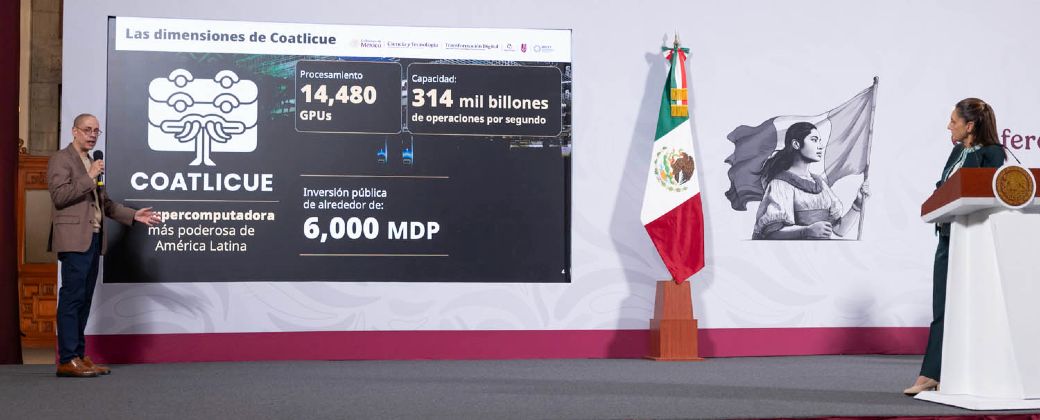
Public investment into the super computer will reach 6 billion pesos (around $330 million USD), an amount that reflects a strategic decision, not a symbolic gesture, in terms of technological innovation.
With this investment, the government aims to build Coatlicue within 24 months, starting in January 2026, and will provide the country with an infrastructure that previously existed only in highly developed nations. The Coatlicue project places artificial intelligence at its core, as the supercomputer will allow for the processing of massive volumes of data and the training of advanced models that are currently impossible in Mexico.
“The recent announcement by the Mexican government regarding the creation of a national supercomputer marks a turning point in the country’s technological discourse. It’s not just about infrastructure, but a clear signal that Mexico wants to play a relevant role in the era of artificial intelligence,” Fermin Muela, leader of the Lottus AI Program, an educational initiative focused on AI, told Aztec Reports.
Where Coatlicue positions Mexico in Latin America’s AI landscape
From a regional perspective, Coatlicue positions Mexico as a leader in Latin America, exceeding seven times the capacity of the largest supercomputer currently operating in Brazil.
In technical terms, Coatlicue will integrate 14,480 GPUs and achieve a capacity of 314 quadrillion operations per second, equivalent to the simultaneous processing of hundreds of thousands of traditional computers.
This power makes Coatlicue a key tool for developing AI models focused on health, climate change, energy, mobility, and advanced analysis of public data.
Coatlicue’s impact is not limited to the scientific field: it also opens the door to entrepreneurial projects and massive computing services for the private sector, with a direct effect on the digital economy.
In educational terms, the benefit is immediate, since having this type of infrastructure raises the level of research, improves learning processes, and allows students and young talent to understand, through hands-on experience, what a supercomputer is for and how it is used, said the Lottus AI Program executive.
The project aims to boost Mexico’s tech sector
In the technology ecosystem, Coatlicue is seen as a positive sign that could trigger new private investments and strengthen public initiatives focused on artificial intelligence.
This project sends a clear message to the market: Mexico seeks to position itself as a relevant player in innovation, scientific research, and technological development, with the capacity to compete globally through its own talent and a high-level infrastructure geared toward the knowledge economy.
The real challenge for Coatlicue lies in its management and strategic utilization, since its impact will depend on transparent and efficient use aligned with concrete results that generate value for society and industry.
Some analysts are already commenting on Coatlicue’s potential for misuse for state surveillance, given Mexico’s history of using spyware like Pegasus on journalists and political opposition members.
“If Mexico manages to promote this project with a long-term vision, Coatlicue will not only accelerate the development of AI, but will also mark the beginning of a new era of technological competitiveness and sustainable growth for the country,” said Muela.
Featured image credit: Gabriel Monroy / Presidencia México.