
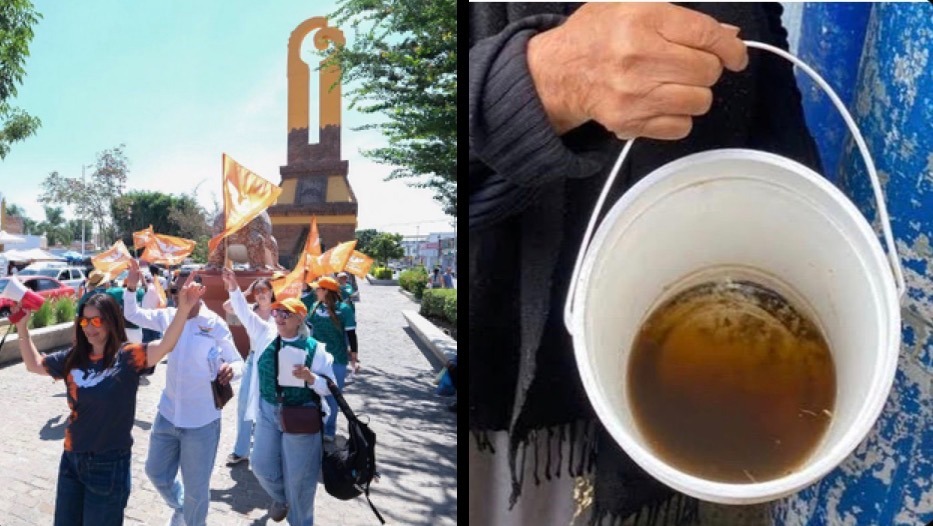

Around 10,000 people marched in Guadalajara, Mexico, on Sunday, October 18, to demand access to clean drinking water.
The protest focused on the management of the water supply, which has been reaching households containing contaminated particles, appearing brown in color, and emitting a foul odor.
Citizens are demanding a temporary suspension of utility charges until a water supply safe for human consumption can be guaranteed, reigniting a long-standing crisis involving Mexico’s Intermunicipal System for Potable Water and Sewerage Services (SIAPA).
In Guadalajara, the capital of Jalisco, demonstrators gathered for the second consecutive week to demand clean water for 320 neighborhoods while in Yucatán, more than 3,000 protesters voiced their opposition to the involvement of foreign private companies in water management.
The protesters assert that water should be guaranteed as a fundamental right, not treated as a business.
They are also calling for immediate infrastructure and sanitation solutions, the issuance of official health alerts, and the assurance that the management of water resources remains strictly under public control to prevent privatization.
The anger of the population erupted during an initial protest on October 11, when about 10,000 people arrived at the Government Palace to demand an immediate solution to the contaminated water coming from their taps.
At the end of the gathering, a group of hooded individuals set fire to the doors of the state Congress and the Government Palace, leading the police to use water cannons and tear gas against the protesters. More than 50 people were reported injured and 39 were detained.
Two days later, the governor of Jalisco, Pablo Lemus, said on X that the agents used excessive force and assured that the detainees were released immediately: “Before being a governor, I am a person.”
During Sunday’s protest, demonstrators choreographed chants expressing that the mobilization was peaceful to avoid a new escalation of violence.
Drinking water in Guadalajara: decades of mismanagement
According to the Mexican Institute for Community Development (IMDEC), residents have been noticing murky and foul-smelling water since at least 2020.
Additionally, various social organizations report that around 200 neighborhoods receive water containing fecal bacteria and heavy metals.
Studies conducted point to iron pipes and drains that have not been renewed in over 25 years. The documents clarify that one of the main causes of contamination is due to municipal discharges and agricultural waste that reach open channels feeding the ‘Las Pintas’ dam.
Given this situation, on October 6, Lemus acknowledged an unprecedented water crisis, cut off the supply from Las Pintas for six months, and began rationing it. The scheduled redistribution of water is expected to continue until March 2027.
The official also proposed a project to the Jalisco Congress to create a new aqueduct called ‘Chapala-Guadalajara’ within two years, at a cost of over US$630 million obtained from public and private funds. However, the project has not yet been approved, as the Parliament canceled the scheduled session on October 15 due to lack of quorum.
For her part, the President of Mexico, Claudia Sheinbaum, offered federal assistance but rejected any type of privatization of the state-owned company and opposed the use of violence to deter the protests.
The water crisis in Mexico: a historical problem
The situation in Jalisco awakens a ghost that haunts Mexico year after year: the recurring water crisis. The United Nations (UN) formally recognizes access to drinking water and sanitation as an essential human right for the full exercise of life.
However, the Latin American country faces a complex structural reality: of the 653 registered aquifers, 44% do not have medium water availability according to the balances of the National Water Commission (Conagua).
The specialist Manuel Perló Cohen stated in the magazine Unam Internacional that Mexico is going through a systemic crisis that requires addressing key failures, such as the loss of up to 35% of water in public networks, the abandonment and operational failure of treatment plants, the overexploitation of aquifers, and the urgent need to coordinate laws and resources.
In this context, the Sheinbaum administration is implementing the National Water Plan 2024-2030, a strategy focused on the modernization of agricultural irrigation, the recovery of water volumes through the review of concessions, and the development of priority infrastructure projects in the most vulnerable regions.
However, some states like Jalisco demand immediate solutions from the local and national governments.
Featured image description: Protesters in Guadalajara (left) and a bucket of dirty water (right)
Featured image credit: @juncalssolano via X