
Mexico exported almost US$83 billion in computer servers to the United States in the first half of 2026, putting them on track to surpass autos and auto parts as the country’s largest export category at year’s close. Over 93% of these server exports are destined for the U.S. market.
Mexico has quietly established itself as a key production and assembly hub for artificial intelligence-related hardware and data center equipment, not only within North American supply chains, but across an interconnected global tech ecosystem that starts with Asian inputs, primarily from Taiwan.
With Mexico and the U.S. due for another round of bilateral trade negotiations later this year, the upsurge in the country’s AI trade may feature as a sticking point or a bargaining chip in the talks.
The Taiwan-Mexico-U.S. Corridor
As Mexico’s server exports to the U.S. have soared, its server imports from Taiwan reached US$28.4 billion in the first half of 2026, already surpassing all of 2025.
Taiwanese manufacturers like Foxconn, crucial players in AI infrastructure and cloud hardware, have built assembly operations in states like Jalisco, Chihuahua, and Baja California. Products like AI servers, racks, and cooling equipment are assembled in these large-scale factories and then exported to U.S. hyperscaler data centers.
But Taiwan has been producing these component inputs domestically for the U.S. market since the late 2010s. So why has Mexico emerged as a booming assembly stopover for AI so recently?
Paulina Anciola, a macroeconomist at Banamex, believes Mexico’s tariff rate became favorable relative to the rest of the world after U.S. President Donald Trump’s Liberation Day tariffs went into effect. “Tariffs for Asian countries supplying key AI components went up significantly,” she said.
Mexico, however, was by no means recused from the force of the newly erected trade walls.
25% tariffs on autos and auto parts and 50% tariffs on steel and aluminum are currently in place, a key flashpoint in stalled trade talks with the U.S.
“The AI hardware industry in Mexico is compensating for the weakness of the auto sector caused by U.S. tariffs,” Anciola added.
USMCA Talks
Following Washington’s July decision to formally decline renewal of the USMCA, Mexico and the U.S. have held three rounds of bilateral talks to reach an interim deal. So far, the U.S. has opted for an annual review of the pact until 2036, but the terms of the interim deal remain gridlocked.
After a formal meeting between Trump and Mexican President Claudia Sheinbaum at the sidelines of the APEC Summit in China last week, both leaders agreed to resume trade talks at the upcoming G20 Summit on December 14.
The booming AI trade corridor between both countries will likely feature at the talks, although it remains unclear who retains greater negotiating leverage in the sector.
“The AI boom helps Mexico defensively,” says Raúl González-Pietrogiovanna, economic development consultant at the Atlantic Council. “The U.S. doesn’t have the AI hardware production capacity Mexico does, and the hyperscalers like Mexico’s speed and reliability, cheap labor, and back-end value-add, especially in cooling systems.”
As the AI corridor between both countries grows, the U.S. might remove tariffs on the AI sector as a bargaining chip in USMCA negotiations.
The main U.S. demand in the talks involves tighter regional content rules for vehicles assembled in Mexico, which it views as overly dependent on inputs from Asian countries looking to sidestep tariffs and enter the U.S. market.
The same content rules, however, may be applied to Mexico’s AI hardware exports, unless the country elevates the industrial value-added it delivers.
“Mexico’s value-added in AI is severely limited by its electric grid,” said González-Pietrogiovanna. “It doesn’t produce the electricity for advanced compute scale, which is what Mexico needs to evolve beyond a server assembly stopover.”
These bottlenecks may ultimately limit Mexico’s local content capacity, with domestic reverberations beyond its AI hardware exporters.
Strategic Separation
President Sheinbaum is committed to positioning AI as an integral part of her economic policy strategy, in the form of the National Artificial Intelligence Plan. The challenge will be to maintain Mexico’s AI sovereignty while facilitating the commercial flows sustaining the country’s economy.
In a press conference in January of this year, Sheinbaum laid out her thoughts on developing AI responsibly, “the companies that own the infrastructure and the platforms are the ones that control information related to artificial intelligence.”
Last month, Mexico began building its first AI supercomputer, Coatlicue, which will become Latin America’s most powerful, with seven times more compute than the last.
Yet the other side of Mexico’s strategy depends on deepening AI supply chain integration with the U.S., leveraging its proximity and relations as a dependable alternative to China in back-end production of AI hardware.
Mexico’s Secretary of Economy, Marcelo Ebrard, discussed this intention ahead of a second round of formal trade negotiations with Washington in June.
Washington’s strategic objective is for semiconductors, a critical component for AI data centers mostly imported from Asia, to be manufactured within North America, Ebrard acknowledged. Mexico participates in the sector, but not at the scale the new market will demand.
“That means multiplying what we do today in semiconductors by about 25 times in three years,” he said.
Maintaining this balance will prove challenging. Upcoming USMCA talks might see renewed demands from U.S. negotiators on higher local content in electronic hardware, forcing the Mexican state to accelerate its value-added in these industries while optimizing for export markets. This could hamstring its push for AI sovereignty and domestic state capacity.
“Mexico’s economic strategy is to facilitate companies’ production for export without interfering too much,” said González-Pietrogiovanna. “It allowed its AI exporters to thrive based on market demand, but it must prioritize state capacity with its own AI systems.”
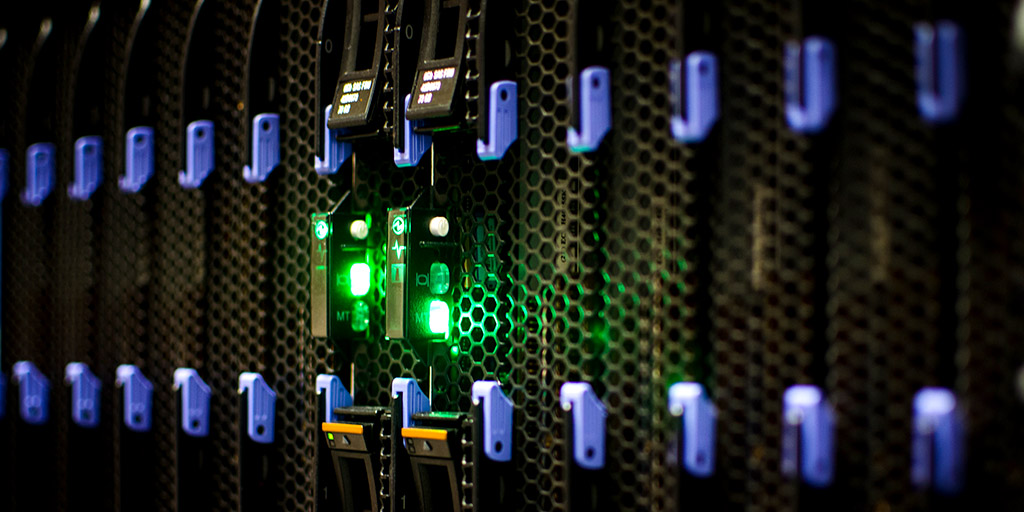
Featured image description: AI Server
Featured image credit: Bob Mical